Santa Claus Village Guided Tour with Arctic Circle Certificate: Honest Review & Tips
I Didn't Expect Lapland winter to Feel Like This
The temperature hit -22°C when I stepped off the bus at Napapiiri on a Tuesday morning in early December. The air had that specific pakkanen quality, so dry and cold that each breath crackles in your nostrils. I'd been to Santa Claus Village dozens of times growing up, but never as a paying customer on a guided tour. My nephew, age six, was with me, and I wanted to see if the guided experience was worth the premium over just wandering in yourself.
We earn a commission when you book through our links on Viator (PID P00303273), at no extra cost to you.
Santa Claus Village is disorienting on first visit. The Arctic Circle line is painted on the ground, and you can cross it fifty times in ten minutes without noticing. The post office handles mail with Arctic Circle postmarks, and Santa's office draws a queue that can swallow an afternoon in peak season. Without context, it's overwhelming. I booked the Santa Claus Village guided tour with Arctic Circle certificate specifically because I wanted someone to explain what I was actually looking at, not just herd me through.
Our guide, a Finnish woman named Sanna who had worked the village for seven winters, collected us from our hotel around ten and drove us out to Napapiiri. The first rule of Santa Claus Village, she said, is don't expect quiet: it is a logistics operation, and the trick is knowing where to look. She was right. We walked the post office, Santa's office and the Arctic Circle line together, and she pointed out corners I had walked past my whole childhood without registering, including the small Sámi display tucked away from the main concourse. I had assumed I knew this place. I didn't.
Somewhere past noon we had our Arctic Circle certificates in hand, proper parchment-style documents with a seal, not a photocopy, and my nephew was thrilled. The whole outing runs about three hours once you count the hotel pickup, the driving and the time in the village, and the certificate is part of what you pay for. We paid roughly the price of a decent dinner back in town for the two of us, and I came away thinking the orientation was worth it for a six-year-old and probably not for me travelling alone. On my own I would have burned an hour in the gift shops and missed half of what Sanna showed us.
Skip this if: You're comfortable navigating a tourist village on your own and don't want the history. You can walk the main concourse in twenty minutes. If you only want the piece of paper, ask at the village information desk whether a certificate can be bought on its own.
Was the guided version worth the premium?
If you want the short answer: yes for a family with small children, and debatable for anyone else. Here is the product as it is actually sold, so you can judge it against your own plan for that day.
Santa Claus Village Guided Tour with Arctic Circle Certificate
Best for families and first-time visitors who want orientation. About three hours door to door, with hotel pickup and drop-off, a guide through Santa's Office and the Post Office, the Arctic Circle crossing and a certificate, and free time to wander. Meals aren't included, and you're paying for logistics and context rather than access to anything you couldn't see alone.
Book Now →The moments that made the trip
After the guided tour, I spent the afternoon exploring the village on my own. In early December the sun barely clears the treeline before it drops again, and what you get for most of the middle of the day is a long, low, peach-coloured twilight rather than direct sunlight. My cousins in Alicante ask me every year whether the days are "short" and I don't think the word does it justice. You are not coming here for sunshine. You are coming for the blue hour that lasts five hours, the stars, and, if you are lucky, the aurora.
I watched a group of Japanese tourists take turns photographing the Arctic Circle line at 13:00, their phones struggling in the low light. A Finnish father nearby was teaching his daughter to ice skate on the small rink near the post office. The temperature had dropped to -25°C. My phone battery went from 80% to 15% in 45 minutes, lithium batteries drain fast in extreme cold. I pulled out my power bank and kept walking.
The village itself is a collection of wooden buildings, gift shops and restaurants. The main draws are Santa's office, where you queue to meet him and can buy a photograph, the post office, where you can send letters with an Arctic Circle postmark, and the painted Arctic Circle line itself. The gift shops run from reindeer skins to plastic snow globes, and the restaurants are priced the way you would expect inside a major tourist attraction. I ate a pulla and a coffee at a small café near the exit and paid about what a round of drinks costs back in town, which for a captive audience felt almost reasonable.
Skip this if: You're looking for a quiet, untouched Arctic experience. Santa Claus Village is a commercial attraction, deliberately so. For genuine wilderness you want to head out of the city entirely, north towards the fells or out to one of the husky and reindeer farms in the surrounding forest, where the only queue is for the sled.
The night I went chasing the aurora instead
The village fills a daytime, but the nights belong to something else. A few evenings after the guided tour I joined a small-group aurora trip run by a local outfit, and the guide, Antero, drove us forty minutes out along the Kemijoki to a clearing where the sky was actually open. At 22:37 the aurora appeared, and it was nothing like the photographs: a pale white smear, barely colour at all, that Antero called a weak display. He set up tripods and walked us through exposure, and by midnight the sky was genuinely rippling. The shots he sent on afterwards showed greens and violets my phone never saw. I had booked the Santa Claus Village guided tour with Arctic Circle certificate for the daylight hours, but the night out was the part of the trip I still talk about. Don't spend the whole budget on the village and leave nothing for the sky.
The thing Antero kept coming back to was mobility. A good aurora guide watches the cloud and drives until the sky opens, sometimes a long way, and the operators who stay parked inside the city and promise you the lights are relying on luck rather than weather. He also warned me that midwinter is not automatically the best time to look: you need darkness, and you need clear sky, and around the equinoxes in September and March you often get both. Weather, not willpower, decides whether you see anything, which is worth remembering before you pay a premium for a guarantee.
Skip this if: You're on a tight budget, or you have only one night in Rovaniemi and it turns out cloudy. Aurora trips are expensive and entirely weather-dependent. Give yourself at least two nights if the lights matter to you.
What Really Surprised Me About Lapland winter
Three things caught me off guard, even as a local.
First, the silence. Twenty minutes outside the village, away from the tour buses, the quiet is absolute. Snow absorbs sound. You hear your own heartbeat, the crunch of boots on frozen snow, the distant crack of a tree branch under the weight of ice. It's disorienting at first. I stood on a frozen lake near Palojärvi at midnight, and the only sound was the aurora, a faint hissing that some people claim to hear (scientists debate whether it's real or psychological).
Second, the cold is not what you expect. At -25°C, exposed skin freezes in under 30 minutes. But with proper layers, merino wool against the skin, fleece over it, a windproof shell on top, I was genuinely comfortable. The mistake tourists make is wearing jeans and a fashion coat. Cotton holds moisture against your skin and that moisture freezes, while wool wicks it away. I live in merino base layers and a proper down parka, and if you don't own that kit, most tour operators will rent you a thermal suit for the day so you aren't buying a wardrobe for one holiday.
Third, the aurora is not Instagram. To the naked eye, the northern lights are usually pale white-green arcs that move slowly. The lively greens, purples, and reds you see in photos are captured with long exposure (2-10 seconds) on a camera with a wide aperture lens. I watched a couple from Spain take photos with their phones and get nothing but black. They were disappointed. Antero explained: "Your phone sensor is too small. You need a mirrorless or DSLR camera with manual controls." I use a Sony A7III with a 14mm f/1.8 lens. If you don't have a proper camera, some aurora tours include photography services, they take photos of you with the aurora and send them after the tour.
Skip this if: You're expecting neon-green skies every night. The aurora is subtle. Manage your expectations and invest in a proper camera or a tour that provides photography.
Mia Ahola's Insider Tips for Getting It Right
I've been guiding tourists in Rovaniemi for four winters. Here's what I tell every visitor:
- Ask an aurora guide how far they will drive. The good ones chase clear sky and will go a long way for it. Be wary of anyone selling a guarantee of the lights, because nobody can promise the weather or the solar activity behind the show.
- Carry a power bank for your phone. Lithium batteries drain in minutes at -20°C, and mine shed charge faster than I have ever seen it do indoors. Keep the bank in an inside pocket against your body so it stays warm enough to work.
- Wear wool base layers, not cotton. Merino is worth the money. A long-sleeve merino top and merino leggings under everything else is what keeps you outside for hours instead of minutes, and cotton next to the skin is what sends people back to the bus.
- Look at how a husky operator treats its dogs before you book. The places worth your money are the ones that limit group size, let you meet the dogs properly, and will talk about how the team is worked and rested. If an operator can't tell you that, ask someone else.
- Ice hotel rooms are not cold. You get an expedition-grade sleeping bag, you sleep in thermals inside it, and you are genuinely warm, which surprises everyone. I stayed in one and woke up sweating. The trick is to strip your outer layer before you get in the bag rather than sleeping in your parka.
- Aurora forecast apps are useful but local knowledge is better. A forecast app gets you the geomagnetic picture; it won't tell you which valley is clear tonight. Guides trade that information with each other, so ask yours rather than trusting the phone alone.
- Eat in Rovaniemi centre, not in the village. The village food is expensive for what it is, and it is a short bus ride back into town where the kitchens are aimed at people who actually live there. Reindeer and salmon are what you came for; the town does both better and cheaper.
- Winter tyres are the norm in Finland from November through March, required whenever weather or road conditions call for them. Rental cars come equipped. Studded tyres help but don't eliminate sliding, so drive for the conditions rather than the posted limit.
- The northern lights don't look like Instagram photos to the naked eye. They're usually pale white-green arcs. Cameras with long exposure capture the colours. If you want photos of yourself with the aurora, book a tour that includes photography services.
- Use the official taxi rank at the airport. Rovaniemi is a small city with a short transfer to the centre, and the airport rank is the straightforward option. Agree the fare or the meter before you get in rather than negotiating after.
- Around the solstice you get twilight rather than sun. Plan anything outdoors for the middle of the day and treat the rest as night. Bring a headlamp for evening walks, because by mid-afternoon it is genuinely dark.
What I Wish I'd Known Before I Went
I've been visiting Santa Claus Village my whole life, but taking the guided tour as a customer taught me things I didn't know. Here's what I wish someone had told me before I booked:
- The guided tour is worth it for families, less so for solo adults. Travelling with young children, the orientation saves time and stress: the guide handles the pickup, the walking order, where to queue and how the certificate works. If you're on your own and happy to wander, you can explore the village without paying for a guide.
- Go early. The village fills up through the middle of the day, and by the time we finished our morning tour it was noticeably busier than when we arrived. Whatever time you book, assume the later you leave it the longer you queue.
- The Arctic Circle certificate is a souvenir, not a legal document. People treat it as proof of something official. It is decorative parchment marking a line painted on the ground. The guided tour includes one, which is convenient if that is the keepsake you want.
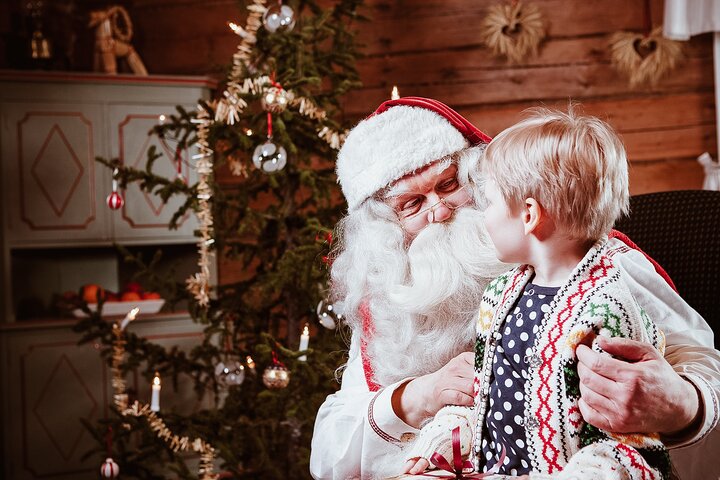
- Don't expect a private audience. Meeting Santa in the office is a staged, well-run experience with a queue behind you, not a quiet fireside chat. My six-year-old nephew did not care about that distinction in the slightest. Some adults do, and leave disappointed.
- Winter paths can be hard work with wheels. The walkways are packed snow and ice, so wheelchairs and strollers struggle between the buildings. There are indoor sections, but getting between them is the difficult part. If mobility is a concern, ask the operator before booking rather than after you arrive.
- Know how you're getting back before it gets dark. I once stood in -20°C cold watching a packed bus pull away, which is a poor way to end a good day. If your transfer isn't included, check the evening timetable in advance so you're not relying on the next one.
Explore More
Related comparisons and guides:
Santa Claus Village Guided Tour with Arctic Circle Certificate
Best for families and first-time visitors who want orientation. About three hours door to door, with hotel pickup and drop-off, a guide through Santa's Office and the Post Office, the Arctic Circle crossing and a certificate, and free time to wander. Meals aren't included, and you're paying for logistics and context rather than access to anything you couldn't see alone.
Book Now →Frequently Asked Questions
Is the Santa Claus Village guided tour worth the money?
It is worth it if you want hotel pickup, a guide through Santa's Office and the Post Office, and the Arctic Circle crossing and certificate handled for you, which is most valuable with children in tow. If you already have transport and enjoy exploring without a schedule, the village is walkable on your own and the tour is a convenience rather than a necessity.
How long does the guided tour take?
Budget about three hours for the whole outing, which includes hotel pickup and drop-off, the guided walk through Santa's Office, the Post Office and the Arctic Circle line, and some free time in the village. If you want to stay on afterwards, ask the operator how that works with the included return transfer.
Do I need to book in advance?
Book ahead for December, which is peak season, and give yourself room to move if your dates are fixed. Outside the Christmas period availability is generally easier, but check the live calendar for the day you actually want.
What is the Arctic Circle certificate?
It is decorative parchment with a seal, marking that you crossed the Arctic Circle at Rovaniemi. It is a souvenir rather than a legal document. The guided tour includes one; if you visit independently, ask at the village information desk whether you can obtain one.
Can I see the northern lights from Santa Claus Village?
You need darkness, clear sky and solar activity, and the village is an illuminated commercial site, so treat any sighting as a bonus rather than a plan. If the lights are a priority, look at a dedicated aurora trip that drives away from the city, and give yourself more than one night.
What should I wear for the tour?
Dress in layers: merino or other wool against the skin, fleece over that, and a windproof shell, with insulated boots and gloves. Avoid cotton. The tour moves between outdoor areas and indoor stops, so you want to be able to shed a layer. If you don't own that gear, many operators rent thermal suits for the day.