The ice was 60cm thick. I booked the trip on Ice Fishing Tour. Our guide drilled a hole, handed me a short rod, and said "now we wait." For an hour I sat on a reindeer skin at -18°C. I caught zero fish. It was wonderful.
I went ice fishing for the first time in February 2019 on Lake Lehtojärvi, 25 km north of Rovaniemi. The guide, a retired forestry worker named Antti, drilled a hole through 60 cm of ice with a hand auger in about 90 seconds. He handed me a short rod with a tiny lure and said: "The fish know you are there. They can feel your footsteps through the ice. Sit still and wait."
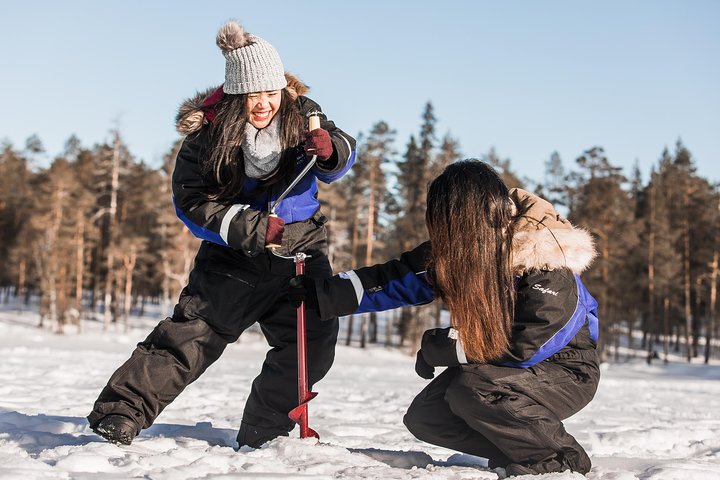
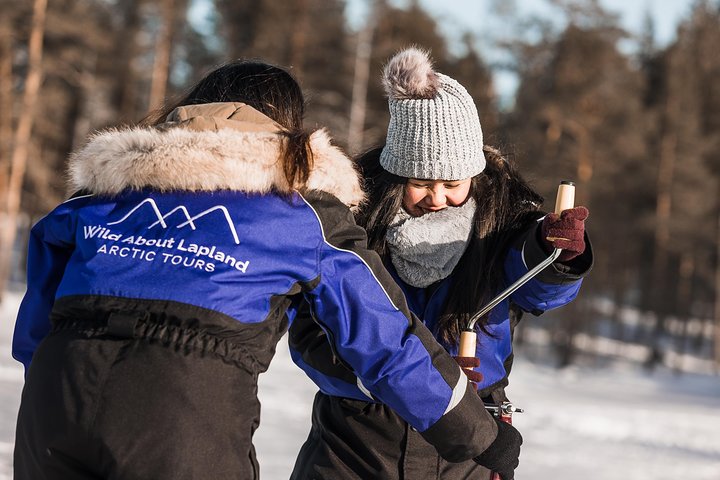
I sat still for 45 minutes in -18°C. My toes went numb inside two pairs of wool socks. Antti brewed coffee over a small fire on the shore. Just as I was about to give up, the tip of my rod twitched, once, then hard. I pulled up a perch the size of my hand. Antti grilled it over the fire with salt and butter and it was the best fish I have ever eaten, partly because I caught it myself and partly because hunger at -18°C is a powerful seasoning.
The Ice Fishing Tour from Rovaniemi includes thermal suits, the snowmobile transport to the lake, and a guide who knows where the fish are, which matters more than any equipment. I have done this tour twice and caught fish both times, which is not guaranteed but the guide's lake selection makes the difference.
The Finnish Art of Ice Fishing, Pilkkiminen
Ice fishing is not a tourist activity that someone invented for Lapland. It is a genuine cultural practice that Finns do on their weekends. Every winter, thousands of Finns drive out onto frozen lakes with a manual auger, a short rod, a reindeer skin to sit on, and a thermos of coffee. They sit in silence for hours. Sometimes they catch perch. Sometimes they catch nothing. Either outcome is considered a successful outing.
The Kemijoki River and surrounding lakes freeze solid from December through April with ice 50-80cm thick by mid-winter, solid enough to drive a snowmobile across. Target species: perch (ahven, small but tasty), Arctic char (nieriä, the prize catch), and occasionally pike (hauki, more fight than flavour). Most guided tours provide all equipment: rod, lure, manual auger, reindeer skin to sit on, and hot coffee or glögi (Finnish mulled wine) prepared over a campfire on the ice.
Your guide drills the hole, about 30 seconds with a manual auger through 60cm of ice. You drop a line baited with a small jig or worm, watch the fluorescent float bob in the dark water, and wait. The fish are typically small (perch are 100-300g) but the excitement of pulling anything through a hole in the ice is disproportionate to its size. When the float dips, a quick upward tug sets the hook. Most tours last 2-3 hours including transport.
Rovaniemi's recorded low temperature is -47.5°C (January 1999). Most winter ice fishing days are -10°C to -20°C, cold but manageable with proper gear. Tour operators provide thermal suits rated to -40°C. Wear wool base layers underneath.
Adrenaline seekers, this is the opposite of a thrill ride. Children under 8, they get cold and bored within 30 minutes. Anyone who cannot sit still in the cold, if you need constant stimulation, book a snowmobile tour instead. I do not recommend this tour for large groups either, the lake experience is about quiet and patience, which dissipates with more than six people.
Honestly, ice fishing is also not for anyone who needs to catch something to feel the experience was worthwhile. Some days you catch nothing. I have sat on a frozen lake for two hours without a single bite, and I still considered it a good afternoon. If catching fish is essential to your enjoyment, book a fishing charter in summer instead. Winter fishing is about the stillness, not the harvest.
My First Ice Fishing Trip
The first time I tried ice fishing, I was 14. My father's friend Matti, a retired forestry worker who spent more time on frozen lakes than on dry land, took us out onto Lake Norvajärvi in late January. The ice was 65cm thick, Matti drove his old Volvo onto it without hesitation. I remember thinking: we are in a car. On a lake. This is not normal.
Matti drilled three holes with a manual auger, about 30 seconds each through the ice, and handed me a rod that was a stick with a short line and a tiny fluorescent jig. "Drop it. Wait. When the float dips, pull up sharply. Do not yank, the perch have small mouths." For the next two hours, I sat on a reindeer skin on a frozen lake at -15°C, staring at a fluorescent orange float bobbing in a circle of dark water. I caught two perch, each about the size of my hand. Matti caught seven. He built a small fire on the ice, brewed coffee in a battered steel pot, and grilled the perch with salt and butter. I have eaten at Michelin-starred restaurants since then. That grilled perch on a frozen lake was better.
Ice fishing, pilkkiminen in Finnish, is not about catching fish. It is about sitting still in a situation that demands nothing from you. The ice creaks and groans as it expands in the cold, a deep, resonant sound that travels for kilometres across the frozen surface. The sky at -15°C is a shade of pale blue that only exists in Arctic winter. Your breath crystallises in the air. Your thoughts slow down. This is why Finns do this every weekend from December to April.
We earn a commission when you book through our links on Viator (PID P00303273), at no extra cost to you.
Northern Lights Rovaniemi: Guaranteed Viewing & Unlimited Mileage
2573 reviews · 4.86★ avg · from €227/person
Top-rated experience in the area. Great reviews, excellent value.
Book Now →Rovaniemi: Northern Lights Pro Guaranteed - Unlimited Distance
878 reviews · 4.87★ avg · from €227/person
Top-rated experience in the area. Great reviews, excellent value.
Book Now →Rovaniemi: 100% Money-Back Guarantee Aurora Tour + Free Photos
871 reviews · 4.87★ avg · from €158/person
Top-rated experience in the area. Great reviews, excellent value.
Book Now →Explore More
Related comparisons and guides:
Photo Gallery

What NOT to Book, Ice Fishing Traps
Ice fishing has become popular enough that operators now package it in ways that strip away everything that makes it worthwhile. Here is what to avoid.
Tours shorter than 2 hours. Some operators offer a "1-hour ice fishing experience" marketed at families and time-conscious travellers. Do the maths: drilling a hole through 60cm of ice takes 2-3 minutes with a hand auger. Baiting the hook, dropping the line, and getting settled on the reindeer skin takes another 5. The guide explains the technique, another 5 minutes. You now have roughly 45 minutes of actual fishing time. Perch do not bite on command. I have gone 45 minutes without a single twitch of the float. A 1-hour tour is a lottery ticket, not a fishing experience. Book a minimum 2-hour tour like the Ice Fishing Tour from Rovaniemi, it gives you enough time for the fish to forget you are there.
Combo tours that add a "Lappish barbecue." I have tested two of these and was disappointed both times. The promise is: ice fishing followed by grilling sausages over an open fire in a traditional kota hut. What you actually get is pre-cooked HK Sininen lenkki sausages (€2.50 for a pack of six at any supermarket) reheated over a fire, served with squirt-bottle mustard and a slice of white bread. You are paying a €35-50 supplement for food that costs the operator roughly €3 per person. The standard ice fishing tour provides coffee and a small snack anyway, the barbecue upgrade is not necessary.
Large-group tours (10+ people). Sound travels through ice. Twelve people walking, talking, laughing, and drilling multiple holes sends vibrations across the entire fishing area. The fish scatter. I tested a group tour with 14 participants in February 2023, we caught two perch between all of us in three hours. The same guide on the same lake the following week with a group of four caught 11 perch in two hours. If the tour description says "small group" but does not specify the maximum, call or message the operator before booking. A group of 4-6 is ideal.
Any tour that guarantees you will catch fish. No honest Lapland guide guarantees fish through a hole in the ice. The fish are wild, the conditions are variable, and luck is a real factor. If a tour operator promises a guaranteed catch, one of two things is happening: they are lying, or they are taking you to a stocked pond where the fish have been fed and the outcome is rigged. A stocked pond is not ice fishing, it is a petting zoo with hooks. Part of the experience is the genuine possibility of catching nothing. That is what makes the actual catch so satisfying.
The March Char, Best Fish of My Life
March 2020, one week before Finland closed its borders for COVID. My uncle Juhani, a man who measures his life in fishing seasons rather than calendar years, insisted we go ice fishing on Lake Perunkajärvi before the ice softened. The temperature was -8°C, practically tropical for March. The ice was still 55cm thick but the surface had turned granular, the way old snow gets when spring is approaching but has not yet arrived.
Juhani refused to use the power auger. "The noise travels 200 metres through the ice," he said. "The perch feel it in their lateral lines. They stop feeding for an hour." He drilled three holes by hand, the steel auger blade biting through the ice in rhythmic turns, the sound a low crunch rather than the angry buzz of a petrol motor. Within 15 minutes, my float dipped, a small perch, maybe 120 grams. I pulled it up and Juhani nodded without smiling. That was his version of enthusiasm.
Twenty minutes later, his rod bent hard. Not the twitch of a perch, the deep, sustained pull of something heavier. He worked the line for maybe four minutes, the short rod flexing nearly double. What came through the hole was a 2-kilogram Arctic char, nieriä, its flanks silver-pink in the pale March light. In Lapland, Arctic char is the prize. It is rarer than perch, smarter than pike, and tastes like something between salmon and trout but cleaner, less oily.
Juhani killed the char with a quick knock to the head, the Finnish way, fast and respectful, then sliced it thin right there on the ice. He laid the translucent pink strips on dark rye bread with a pinch of coarse sea salt. Graavattu tuoreeltaan, graved fresh, right on the lake. The flesh was still cold from the water, the texture almost firm like sashimi but sweeter. I have eaten at Michelin restaurants in Helsinki and Copenhagen. That char, eaten standing on a frozen lake with numb fingers and wind-chapped lips, was better than all of them. You cannot buy that experience. You can only stand on the ice and wait.
My Friend from Barcelona, The Worst 2 Hours of His Life
February 2022. I took my friend Carlos, born and raised in Barcelona, where "cold" means 8°C, ice fishing on Lake Lehtojärvi. Temperature: -24°C with a 3 m/s wind. I told him to wear wool. He nodded and said he had bought "thermal underwear" from a Spanish sports shop.
They were cotton thermals. Not merino, not synthetic, cotton, with a thin fleece lining that did nothing once the cotton absorbed his sweat from the walk from the car to the lake. Within 12 minutes of sitting on the reindeer skin, his teeth were chattering uncontrollably. Not the polite shiver of someone who is a bit cold, the full-body convulsive shudder of someone whose core temperature is dropping. I made him stand up and do jumping jacks on the ice while I drilled the holes. The Finnish couple fishing 50 metres away watched with the quiet amusement of people who have seen this exact scenario play out dozens of times.
He lasted two hours. He caught nothing. I caught one perch, maybe 150 grams, which I released because grilling one tiny fish felt sad. On the drive back to Rovaniemi, Carlos sat in the heated van with his hands pressed against the dashboard vents and said, "That was the worst two hours of my life."
He still brings it up every time we talk. He tells the story at dinner parties in Barcelona. He shows people photos of himself on the ice, wrapped in a thermal suit, looking miserable. It has become his best travel story. That is the thing about ice fishing: the suffering is the point. The worst two hours of your life becomes the story you tell for years. And if you are lucky enough to catch a fish, even a perch the size of your palm, you will remember the taste of it more vividly than any meal you ate in warmth and comfort.
Local Wisdom: How to Actually Catch Something
The evening bite is real. Finnish anglers have a word for it: iltapurenta, the evening feeding window. Perch and char feed most actively in the two hours before sunset, when the light is low and the water cools further. In December, that means roughly 13:00-15:00. In March, it shifts to 16:00-18:00. Book the latest afternoon tour slot available. I have caught more fish between 14:00 and 16:00 than in all other hours combined.
Buy the smallest jigs. If you are bringing your own equipment, buy jigs in the 2-3mm range, smaller than anything you would use in open water. Tourists invariably buy jigs that are too large. Lapland lake perch have small mouths and feed primarily on tiny freshwater invertebrates and insect larvae. A 5mm jig looks like a meal to you; to a perch, it looks like a threat. The most productive colour in Rovaniemi's lakes is fluorescent orange or chartreuse. Bring spares, you will lose jigs to the ice hole rim.
Do not fear the ice groan. When the ice expands in the cold, it produces a deep, resonant boom that travels for kilometres across the frozen surface. It sounds exactly like the ice is cracking beneath you. Tourists visibly panic the first time they hear it, I have watched people instinctively stand up and start walking toward shore. The ice on Rovaniemi's lakes is 50-80cm thick in mid-winter. That is enough to support a pickup truck. The groan is not structural failure, it is the ice expanding as the temperature drops further, the same physics that cracks a glass when you pour boiling water into it, just on a much larger scale. Finns find the sound comforting. It means the ice is cold enough to be safe. Give yourself 15 minutes, the panic fades and eventually the groan becomes background noise, like wind in trees.
Sit completely still. Not just quietstill. Perch detect vibration through their lateral lines, and a restless person shifting weight on a reindeer skin sends pressure waves through the ice that travel farther than sound. Antti, the retired forestry worker who taught me to ice fish, would sit motionless for 20 minutes at a stretch, his breath the only movement. "The fish need to forget you exist," he said. "Then they come back." He was right. Every time I have caught multiple fish in a session, the first 20-30 minutes were silent and still. The bite always came after I stopped fidgeting.
First Ice, Midwinter, Last Ice: When the Bite Actually Happens
Ask a Finnish angler when to fish and they will not name a month. They will name a condition: first ice. The weeks after a lake locks over for good, while the water underneath still holds the season's oxygen and the fish are hungry and unbothered, are the best fishing of the winter. The shallows and sand shelves fill up first, and the catches come fast while they last. Then the season settles into its quiet middle. Through the dark weeks of midwinter, the daylight is down to a few pale hours, the water sits close to freezing from top to bottom, and the perch slow down the way everything in Lapland slows down. The holes that were alive in December go silent, feeding windows shrink to minutes, and February catches are modest achievements, honestly reported. Nothing about this is scheduled, either: in some mild winters the lakes take their time locking over, and the operators worth booking wait until the ice has been tested and re-tested before the first group goes out.
Then comes the turn. From late February the light climbs back, the water begins to warm under the ice, and the fish start feeding again, building toward spring. March and early April are the season's real prize: perch move into shallow feeding flats two to six metres deep, the biggest females of the year feed hard before spawning, and the Arctic char these lakes are known for can still come up through the ice. My uncle caught his two-kilo char in March, and timing helped. If catching matters to you, these are the weeks to book, and they are also the weeks when a late-ice safety note does some real work: by April the surface turns slushy and the shoreline pulls away first, which is why responsible operators re-check the ice through the season, not just when it forms. If you book the Ice Fishing Tour from Rovaniemi in late season, ask which lake you will fish and when it was last checked. The answer tells you more than the price.